
Ankle-brachial index · Sibiu
The ankle-brachial index in Sibiu, five minutes that show how blood flows in your legs

A simple comparison between the blood pressure at your ankle and the one at your arm shows whether the arteries of the legs have narrowed. The same figure says something about the heart as well.
What the ankle-brachial index is
The ankle-brachial index is a simple measurement that compares the blood pressure at your ankle with the one at your arm. Blood pressure is measured in both arms and at both ankles, then the ankle value is divided by the higher arm value. The result is a number, and that number says how well blood flows through the arteries of the legs.
The logic behind it is easy to follow. In someone with clear arteries, the pressure at the ankle is at least equal to the pressure at the arm. If an artery in the leg has narrowed because of atherosclerotic plaque, the pressure beyond the narrowing drops and the ratio falls below 1.
The investigation is also known as the ABI, from ankle-brachial index. It is non invasive, involves no needles, no contrast agents and no radiation, and it is done with a blood pressure cuff and a pocket Doppler probe that listens to the flow in the artery at the ankle.
What the measurement is really looking for is peripheral arterial disease, that is atherosclerosis in the lower limbs. The important detail is that a low value does not speak about the legs alone. A patient with peripheral arterial disease statistically carries a higher risk for the heart and the brain as well, because atherosclerosis is a disease of the whole arterial system, not of one segment.
That is why the measurement plays a double role at a cardiology clinic. It is a test for the legs and, at the same time, an indicator of overall cardiovascular risk, obtained in a few minutes and with no discomfort.
When it is worth measuring
Most patients arrive at this investigation from two directions: either they have a symptom when walking, or they have risk factors that justify a check even though they feel nothing.
- Your calf, thigh or buttock hurts when you walk and the pain eases when you stop
- You feel weakness or cramps in your legs on exertion, always after the same distance
- You have diabetes, especially for more than ten years
- You smoke or smoked for many years
- You have high blood pressure or raised cholesterol
- You are over 65, or over 50 if you have diabetes or smoke
- You have a wound on your foot or toe that is not healing at the usual pace
- The skin on your calves is thin and shiny, with less hair, or your feet are cold
- Plaque has been found in your carotid arteries, or you have already had a cardiovascular event
- You have chronic kidney disease or a family history of early arterial disease
If you have pain in your leg at rest, especially at night, or a wound that is turning black, do not wait for an ordinary appointment. Those are signs that call for prompt assessment.
How the measurement goes
It takes about fifteen minutes, is done lying on the examination couch, and does not hurt.
Resting first
You lie on your back for five to ten minutes so your blood pressure settles. If you have climbed stairs or arrived in a hurry, that wait matters, because otherwise the readings come out falsely high.
Measuring at the arms
The cuff goes on each arm and the systolic pressure is measured, with the Doppler probe over the artery at the wrist. Both arms are used, because a large difference between them is itself meaningful.
Measuring at the ankles
The cuff moves down to the calf, just above the ankle, and the probe listens in turn to the posterior tibial artery and the dorsalis pedis artery, on each foot. You hear a sound like a wave, which is your own blood flow.
The calculation
For each leg the higher ankle value is taken and divided by the higher arm value. That gives two indices, one for the right leg and one for the left, and the lower of the two carries the verdict.
The conversation
I explain what the number means in your case, alongside the rest of the picture: blood pressure, cholesterol, blood sugar, smoking, symptoms. You leave with the interpretation in writing and with the next steps, if any are needed.
How the result is read
Between 1.00 and 1.40 the value is considered normal. The arteries of the legs carry blood without a significant narrowing.
Between 0.91 and 0.99 the result is borderline. It does not mean established disease, but it does mean the measurement is worth repeating and following, especially if you have symptoms or risk factors.
At 0.90 or below we are talking about peripheral arterial disease. From there on, what matters is how low the value is and what symptoms you have, and the next step is usually an arterial Doppler ultrasound, which shows exactly where the narrowing sits.
Above 1.40 the number can no longer be read as such. A value that high appears when the arteries are stiff and no longer compress under the cuff, which happens often in patients with long standing diabetes or kidney disease. In that case other methods are used, for example the toe-brachial index.
These thresholds are the ones in the 2024 European guidelines on peripheral arterial and aortic diseases and in the American Heart Association statement on measuring the index. They are not the clinic's thresholds, they are international ones.
What follows an abnormal result
A low index is not a sentence, and it does not send anyone straight to surgery. In most cases the first step is treating what caused the narrowing: stopping smoking, controlling cholesterol with a statin, controlling blood pressure and blood sugar, often an antiplatelet drug.
The second step, just as important, is walking. A supervised walking programme is one of the few interventions that concretely improve the distance you can cover without pain, and the effect shows in weeks, not years.
Further investigations, an arterial Doppler ultrasound for instance, are recommended when symptoms limit everyday life or when the value is markedly low. The decision to intervene belongs to vascular surgery, and the role of the consultation here is to establish whether and when a referral makes sense.
In parallel, a low index also changes the way we look at the heart. The patient's cardiovascular risk is recalculated upwards and prevention becomes firmer, even if the heart has given no sign yet.
Prices
| Service | Price |
|---|---|
| Cardiology consultation + ECG | 400 lei |
| Cardiology consultation + ECG + echocardiography | 620 lei |
| Cardiology follow-up + ECG | 300 lei |
| Echocardiographyincludes an orientative assessment of the liver, the carotid arteries and the thyroid | 400 lei |
| Holter ECG monitoring24 hours | 370 lei |
| Ambulatory blood pressure monitoring (ABPM)24 hours | 370 lei |
| Exercise stress test on a cycle ergometer | 450 lei |
| Body composition analysis | 100 lei |
| Ankle-brachial index (ABI)with interpretation | 100 lei |
| Electrocardiogram (ECG) | 100 lei |
| ECG + SDS (sudden death screening)extended BTL assessment, for people up to the age of 35 | 150 lei |
| Intravenous Ferinject 500 mgmedication and medical supervision included | 800 lei |
| Intravenous vitamin C (Pascorbin 7.5 g)product and medical supervision included | 350 lei |
You have seen the prices. Shall we go ahead?
Tell us what brings you to a cardiologist and we will suggest a time that works for you.
Frequently asked questions
Does measuring the ankle-brachial index hurt?
How long does it take?
How do I prepare?
What are the normal values?
What does a value below 0.9 mean?
Does a normal result completely rule out disease in the leg arteries?
Why is it measured in both legs and both arms?
How often should it be repeated?
I have had diabetes for years. Does that matter?
Can it be done in the same visit as the consultation?
Do I need a referral?
What do I take home after the investigation?
Ankle-brachial index in Sibiu
The Biocord practice is at Strada Ion Agârbiceanu 11, Sibiu, in the Turnisor neighbourhood.
Phone: 0771 193 295
Email: bio.cord@yahoo.com
Appointments are made by phone or through the form on this site. We confirm the time before you come.
Open in Google Maps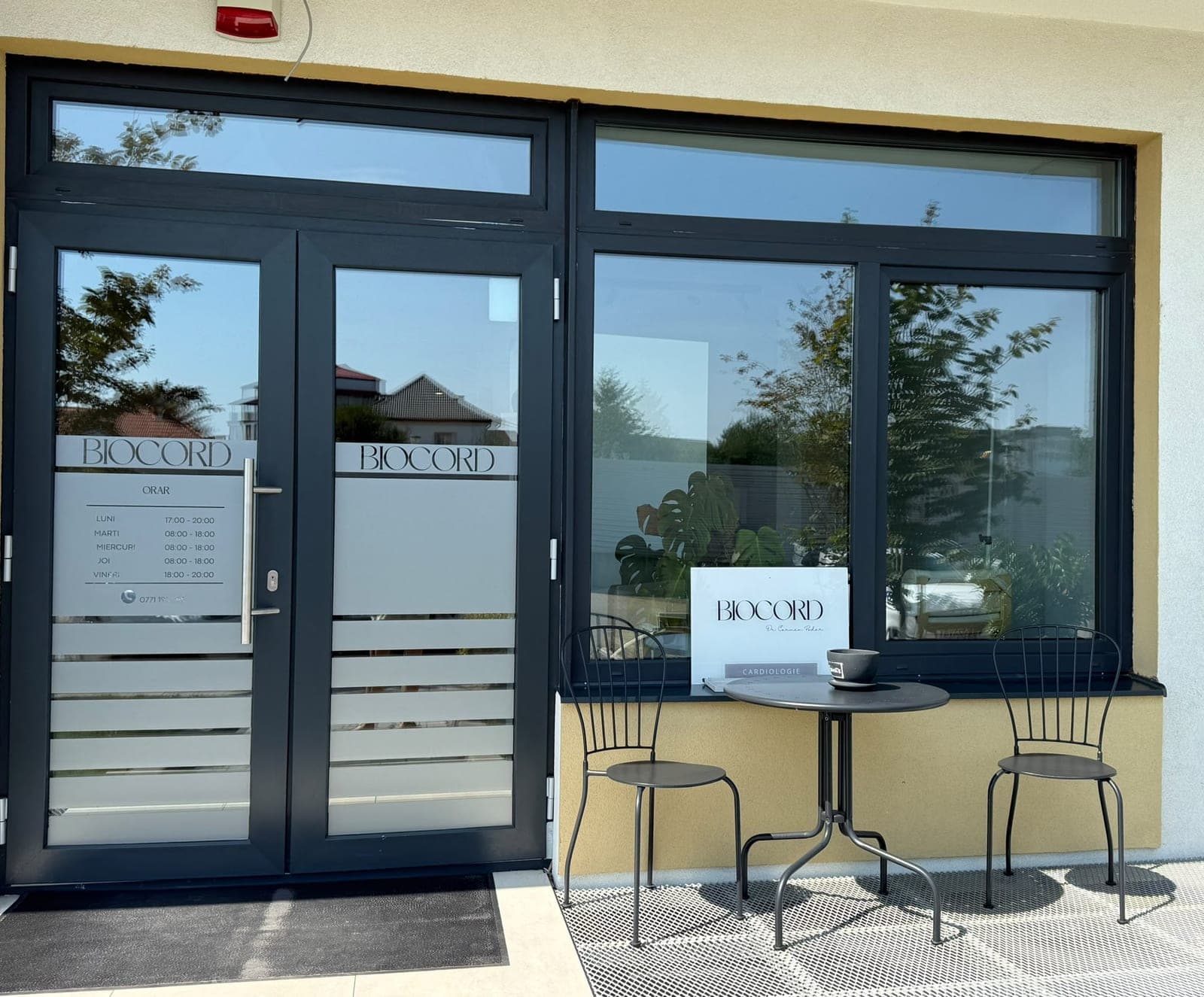
Services that go together with this one
- Cardiology consultationA consultation that does not stop at the reason you came in. We go through your history, your test results, your lifestyle and your risk factors, then build a long term prevention plan together.
- EchocardiographyA heart ultrasound shows how your heart looks and how it works. In the same session we take a preliminary look at the liver, the carotid arteries and, when needed, the thyroid, at no separate cost.
- Body composition analysisWeight on its own says almost nothing. Body composition shows the balance between fat and muscle, and that is where the practical recommendations start.

Book ankle-brachial index
We confirm the time by phone and tell you whether any preparation is needed.