
Holter ECG · Sibiu
Holter ECG monitoring in Sibiu, for the palpitations that never happen at the clinic

An electrocardiogram lasts a few seconds. If your symptoms show up in the evening, during exercise or once a week, you need a continuous recording that can catch them.
What Holter ECG monitoring is
The Holter ECG is a small device, worn on your belt or hung around your neck, that records the electrical activity of the heart continuously for 24 to 48 hours, sometimes longer. It connects to the skin through a few adhesive electrodes stuck on your chest.
Its purpose is simple. A standard electrocardiogram lasts a few seconds and catches the heart exactly as it is at that moment, at the clinic, at rest. If your symptoms turn up in the evening, on exertion, in your sleep or once every few days, there is little chance they will land in exactly those seconds.
The Holter solves that through duration. The recording covers a whole day of your ordinary life, with everything that involves: work, climbing stairs, meals, stress, sleep. That is how it can catch rhythm disturbances, pauses, episodes of tachycardia or bradycardia, and the changes that suggest ischaemia without pain.
The key to a successful recording is not changing your routine. A Holter worn on a day you spent on the sofa so as not to disturb the device says far less than one worn on a normal day.
When a Holter ECG is useful
Most indications start from a symptom that comes and goes, or from the need to check whether a treatment is doing what it should.
- You have palpitations, a racing heart, or the feeling that your heart skips a beat
- You have episodes of dizziness, or you have fainted with no clear explanation
- You have been diagnosed with atrial fibrillation and it needs following over time
- Extra beats were found on an electrocardiogram and nobody knows how frequent they are
- Your pulse is very slow, or you feel drained, with a sense of everything slowing down
- You have started or changed a treatment for your rhythm and the effect needs checking
- You have had a stroke with no identified cause
- You have symptoms that turn up only at night or only on exertion
- You have known or suspected sleep apnoea, with snoring and waking in the night
- You have a heart condition being followed, and the rhythm needs reassessing from time to time
If right now you have chest pain that will not go away, severe difficulty breathing, or you have fainted, do not wait for an appointment. Call 112.
How it goes, from fitting to result
Monitoring involves two short visits, one to fit the device and one to hand it back.
Fitting the device
The skin is cleaned where the electrodes go, and for men with chest hair a small area is shaved so the adhesive holds. The electrodes are connected to the recorder, the signal is checked, and you go home with it. Come in a loose top that fastens at the front.
An ordinary day
You carry on with your normal routine: work, walking, chores, sleep. The only real restriction is water. The device must not get wet, so no shower, bath or swimming pool while you are wearing it.
The diary
You write down the time any symptom appears, with a word about what you were doing then. Palpitations at 19:40, climbing stairs. Dizziness at 6:15, when I got out of bed. That diary is half the value of the test.
Handing the device back
You come back to the clinic, the electrodes are taken off and the recording is downloaded. A light mark from the adhesive may stay on the skin, and it fades on its own.
The interpretation
The recording is analysed beat by beat, with the help of the software, and then everything it has flagged is checked by hand. At the end you get the conclusion explained and, if needed, the adjustment to your treatment or the next steps.
What a day with the device on is actually like
The device is light and fits under your clothes. Most people say that after the first hour they forget about it, except for the moment they get undressed. A looser top and clothes that fasten at the front make everything simpler.
The shower is the one clear sacrifice. Neither the electrodes nor the device tolerate water, so washing has to be partial, with care around the chest. It is worth having a shower right before it is fitted, so you start out clean.
Sleeping is usually possible without any trouble. Put the device next to you on the bed or under the pillow, so you do not pull on the leads when you turn over. Even if you feel you slept worse than usual, the recording from the night is often the most valuable part.
You can go to work and you can do your usual exercise. Just avoid heavy sweating, intense sport and the sauna, because the electrodes come unstuck. If your normal routine includes training sessions, tell us at booking so we can pick the right day.
If an electrode comes unstuck, press it back on firmly for a few seconds and note the time in your diary. Do not switch the device off and do not pull the leads out. Even if a section of the tracing comes out with artefact, the rest of the recording is still useful.
What we are actually looking for in the recording
The first category is the extra beats, the ectopic beats. Almost everyone has a few in a day. What matters is how many there are, where they start from and whether they come in groups, because that is what decides whether treatment is needed or just reassurance.
The second is atrial fibrillation and the other fast arrhythmias. Sometimes they come in short bursts, which the patient feels as palpitations that pass on their own. Finding them changes the treatment decision completely, especially when it comes to preventing a stroke.
The third category is the rhythms that are too slow, and the pauses. A slow pulse in an athlete, during sleep, can be normal. The same figures in someone who gets dizzy or faints mean something else. What makes the difference is exactly that link with the symptom diary.
We also look for the changes that suggest silent ischaemia, that is an insufficient blood supply to the heart muscle that does not show itself as pain. It is one of the reasons a prolonged recording has value in someone with risk factors.
Above all of that, the most important question is still whether your symptoms match what is seen on the tracing. A result showing that your palpitations correspond to benign ectopic beats is a good result, not an empty one.
Holter ECG and blood pressure Holter, two different devices
A lot of people use the word Holter for both, but they are separate tests. The Holter ECG records the electrical activity of the heart, so the rhythm. The blood pressure Holter, properly called ABPM, automatically measures the blood pressure at regular intervals, through a cuff on your arm.
Which one you have depends on the question. Palpitations, dizziness, an irregular pulse or missed beats mean a Holter ECG. Blood pressure that swings a lot, high readings only at the clinic, a suspicion of night time hypertension, or a treatment that needs adjusting, mean ABPM monitoring.
There are also situations where both are useful, usually some time apart. At the consultation we decide which one you need and in what order, so that you do not wear a device for nothing.
Prices
| Service | Price |
|---|---|
| Cardiology consultation + ECG | 400 lei |
| Cardiology consultation + ECG + echocardiography | 620 lei |
| Cardiology follow-up + ECG | 300 lei |
| Echocardiographyincludes an orientative assessment of the liver, the carotid arteries and the thyroid | 400 lei |
| Holter ECG monitoring24 hours | 370 lei |
| Ambulatory blood pressure monitoring (ABPM)24 hours | 370 lei |
| Exercise stress test on a cycle ergometer | 450 lei |
| Body composition analysis | 100 lei |
| Ankle-brachial index (ABI)with interpretation | 100 lei |
| Electrocardiogram (ECG) | 100 lei |
| ECG + SDS (sudden death screening)extended BTL assessment, for people up to the age of 35 | 150 lei |
| Intravenous Ferinject 500 mgmedication and medical supervision included | 800 lei |
| Intravenous vitamin C (Pascorbin 7.5 g)product and medical supervision included | 350 lei |
You have seen the prices. Shall we go ahead?
Tell us what brings you to a cardiologist and we will suggest a time that works for you.
Frequently asked questions
Why is a standard electrocardiogram not enough?
How long does the device have to be worn?
Can I shower with the Holter fitted?
Can I sleep normally with the Holter?
Can I go to work and can I exercise?
What do I do if an electrode comes unstuck?
Do I take my medication as usual?
Do I have to write down everything I do in the diary?
How is the result interpreted and when do I get it?
Do I need a referral letter, and can it be fitted at home?
Holter ECG in Sibiu
The Biocord practice is at Strada Ion Agârbiceanu 11, Sibiu, in the Turnisor neighbourhood.
Phone: 0771 193 295
Email: bio.cord@yahoo.com
Appointments are made by phone or through the form on this site. We confirm the time before you come.
Open in Google Maps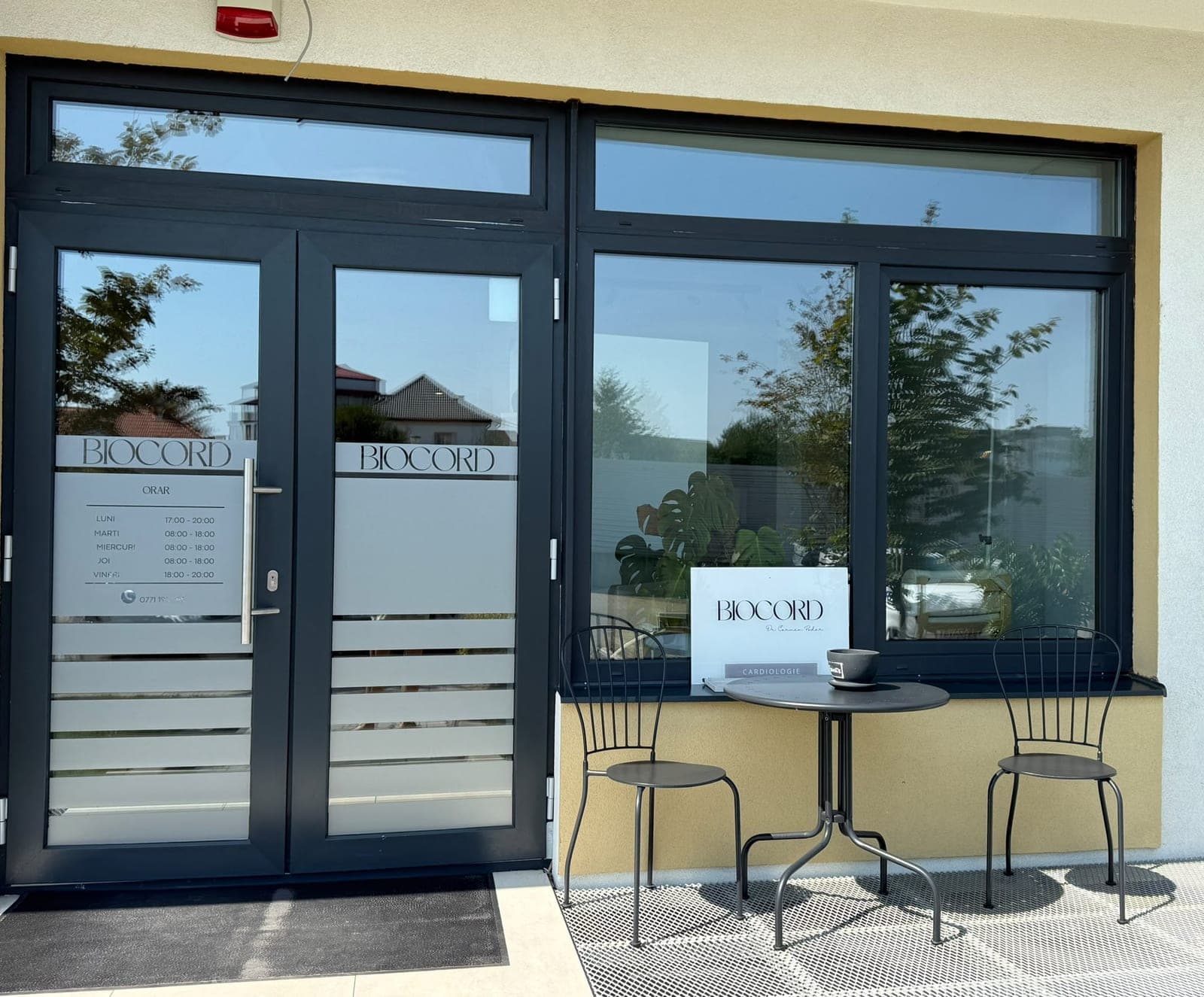
Services that go together with this one
- Blood pressure monitoring (ABPM)A single reading at the clinic says very little. ABPM records your blood pressure at regular intervals, day and night, and shows the real pattern, including what happens while you sleep.
- Electrocardiogram (ECG)The basic test of the heart: a few minutes, with no discomfort. Its value lies in the reading, that is, in what your tracing means alongside the rest of your story.
- Cardiology consultationA consultation that does not stop at the reason you came in. We go through your history, your test results, your lifestyle and your risk factors, then build a long term prevention plan together.

Book holter ecg
We confirm the time by phone and tell you whether any preparation is needed.