
ABPM · Sibiu
24 hour blood pressure monitoring in Sibiu

A single reading at the clinic says very little. ABPM records your blood pressure at regular intervals, day and night, and shows the real pattern, including what happens while you sleep.
What 24 hour automatic blood pressure monitoring is
Blood pressure is not a fixed number. It climbs with exertion and with emotion, it drops while you sleep, and it reacts to coffee, to a bad night or to a tense conversation. One reading at the clinic is a single photograph taken from a twenty four hour film.
Ambulatory blood pressure monitoring, also known as ABPM or a “blood pressure Holter”, films the whole thing. You wear a cuff on your arm, connected to a small device clipped to your belt, and it inflates by itself at regular intervals, day and night, without you having to do anything.
At the end, the data is downloaded and you get something no single reading can give you: the 24 hour average, the average across your active hours, the average during sleep, and how much the values swing over the course of the day.
This method gives a clear picture of how your blood pressure fluctuates during the day and during the night. It is essential for a correct diagnosis of hypertension and for adjusting antihypertensive treatment, which is to say for exactly the two decisions where a mistake costs the most.
The device records, it does not decide. The interpretation happens in context: what symptoms you have, what treatment you are taking and what the rest of the assessment shows. A sheet of numbers, read on its own, is not a diagnosis.
When 24 hour monitoring makes sense
Sometimes your doctor asks for it, sometimes it starts from a mismatch you spotted yourself between the machine at home and the one at the clinic. Monitoring is worth doing if you recognise yourself below.
- Your blood pressure comes out high at the clinic, but at home the readings look normal
- You get high readings at home, but at the doctor everything seems fine
- You have been told your blood pressure is borderline and it is not clear whether you need treatment
- You are about to start antihypertensive treatment and you want the decision to come from data, not from two readings
- You are already on treatment and you do not know whether the dose is enough or, on the contrary, too high
- You have felt dizzy or tired since you started or changed your medication
- Your readings vary a lot from one measurement to the next and you cannot tell which one is the real one
- You wake up with headaches, you snore loudly, or you have been told that you pause your breathing in your sleep
- You have diabetes, chronic kidney disease or metabolic syndrome, situations where your blood pressure profile during sleep matters a great deal
- You were diagnosed with hypertension at a young age and you want solid confirmation before starting long term treatment
If right now you have very high readings together with chest pain, serious difficulty breathing, disturbed vision or weakness down one side of your body, do not wait for an appointment. Call 112.
How the monitoring goes
The device is fitted at the clinic, you wear it for a full day while keeping to your usual routine, then you bring it back so the data can be downloaded.
Getting ready
You need no medical preparation at all. Wear a loose top or shirt with a sleeve wide enough to go over the cuff, because the cuff stays directly on your arm the whole time.
Fitting the device
We take a reference reading, choose the right cuff size and fit the device. You get an explanation of what to do when the cuff inflates and how to fill in the diary.
The 24 hours
Live your day as normal. That is exactly the point: your blood pressure in your real life, not from a day spent sitting in a chair. Note down your sleeping hours, any exertion, the medication you took and any symptoms.
Handing the device back
The next day you bring the device back, the recording is downloaded and a report is generated with all the readings, the averages for each period and the graph of how your pressure moved through the day and the night.
Interpretation and the decision
The result is read through together with you, alongside your symptoms and your current treatment. The decision starts from there: treatment is started, an existing one is adjusted, or we simply set the rhythm for follow up.
How to read blood pressure numbers
Blood pressure is written as two numbers. The first is the systolic pressure, the pressure in your arteries at the moment your heart contracts. The second is the diastolic pressure, the pressure left between two beats, while the heart relaxes and fills. Both matter, and one of them being raised on its own is enough to put a question mark there.
The thresholds the guidelines work from differ depending on where the measurement is taken, and that surprises a lot of people. At the clinic, hypertension is discussed from 140 over 90 mmHg upwards. At home, with a validated device, the threshold sits around 135 over 85. For 24 hour monitoring, the guidelines use a whole day average from 130 over 80 upwards, an average across the active period from 135 over 85, and an average during sleep from 120 over 70.
The reason the thresholds are lower for monitoring is simple: a 24 hour recording holds a great many readings, taken in ordinary conditions, without the tension of the clinic. The resulting average sits closer to reality, so the point at which concern begins comes down.
These figures are guideline reference points, not verdicts. They say where the conversation starts, not what you have. Where you actually fall depends on your age, on other conditions, on your treatment, on your overall cardiovascular risk and on your symptoms. Two people with the same average can be given different recommendations, and that is settled at the consultation.
Two things that come up often. In adults, the diagnostic thresholds do not relax with age, even though treatment targets can be gentler in older or frail people. The idea that “at 70 it is normal to run 170” does not hold up. And your pulse is a different parameter, read separately: a fast pulse does not automatically mean high blood pressure.
As for exertion, it is normal for systolic pressure to rise when you climb stairs or lift something heavy, and then to come back down. A proper reading is taken sitting down, with your back supported, after five minutes of quiet, with your arm supported at heart level, not straight after exertion or after coffee.
Why one reading at the clinic can mislead you
There is a well described phenomenon called white coat hypertension. Your blood pressure climbs in the consulting room for the simple reason that you are there, and it returns to normal for the rest of your life. If the decision is made on those readings alone, you can end up on treatment you do not need, with dizziness and tiredness as the price.
There is a mirror image of it, more dangerous, called masked hypertension. At the clinic the numbers look lovely, and through the rest of the day, at work, in traffic or at night, the pressure is high. Here the risk is not one treatment too many, it is years in which real hypertension goes undiagnosed.
A related situation shows up in people already on treatment: the clinic readings stay high despite the medication, but monitoring shows that in real life the pressure is in fact controlled. Without that check, medicines can be added for nothing.
24 hour monitoring separates these situations from one another, because it does not depend on a single day and a single room.
What happens to your blood pressure in your sleep, and why it matters
Normally, blood pressure falls during sleep compared with the active part of the day. That fall is natural, the nocturnal dipping profile, the sign that the nervous system has moved into rest mode. Night time readings are the only way to see whether that happens in your case, because nobody wakes up hour after hour to measure themselves.
When the dip during sleep is missing, or when pressure climbs at night instead of falling, the picture changes. It is a pattern that deserves attention, and the causes are looked for further out: sleep apnoea, kidney disease, diabetes, treatment taken at the wrong time of day, or poor quality sleep.
The link with sleep apnoea is the one we most often see missed. Loud snoring, pauses in breathing noticed by your partner, sleep that does not rest you, a morning headache and blood pressure that is hard to control often travel together. If the night recording raises that suspicion, a dedicated investigation follows.
Prices
| Service | Price |
|---|---|
| Cardiology consultation + ECG | 400 lei |
| Cardiology consultation + ECG + echocardiography | 620 lei |
| Cardiology follow-up + ECG | 300 lei |
| Echocardiographyincludes an orientative assessment of the liver, the carotid arteries and the thyroid | 400 lei |
| Holter ECG monitoring24 hours | 370 lei |
| Ambulatory blood pressure monitoring (ABPM)24 hours | 370 lei |
| Exercise stress test on a cycle ergometer | 450 lei |
| Body composition analysis | 100 lei |
| Ankle-brachial index (ABI)with interpretation | 100 lei |
| Electrocardiogram (ECG) | 100 lei |
| ECG + SDS (sudden death screening)extended BTL assessment, for people up to the age of 35 | 150 lei |
| Intravenous Ferinject 500 mgmedication and medical supervision included | 800 lei |
| Intravenous vitamin C (Pascorbin 7.5 g)product and medical supervision included | 350 lei |
You have seen the prices. Shall we go ahead?
Tell us what brings you to a cardiologist and we will suggest a time that works for you.
Frequently asked questions
Does 24 hour blood pressure monitoring hurt?
Can I sleep with the device on?
Can I shower or have a bath?
Can I go to work and do sport?
What do I do when the cuff starts to inflate?
Why is a full 24 hours needed, and readings at night?
Do I take my usual medication on the day of the monitoring?
Are a “blood pressure Holter” and ABPM the same thing?
Do I need a referral letter or any paperwork?
When do I find out the result and what do I get at the end?
Blood pressure monitoring (ABPM) in Sibiu
The Biocord practice is at Strada Ion Agârbiceanu 11, Sibiu, in the Turnisor neighbourhood.
Phone: 0771 193 295
Email: bio.cord@yahoo.com
Appointments are made by phone or through the form on this site. We confirm the time before you come.
Open in Google Maps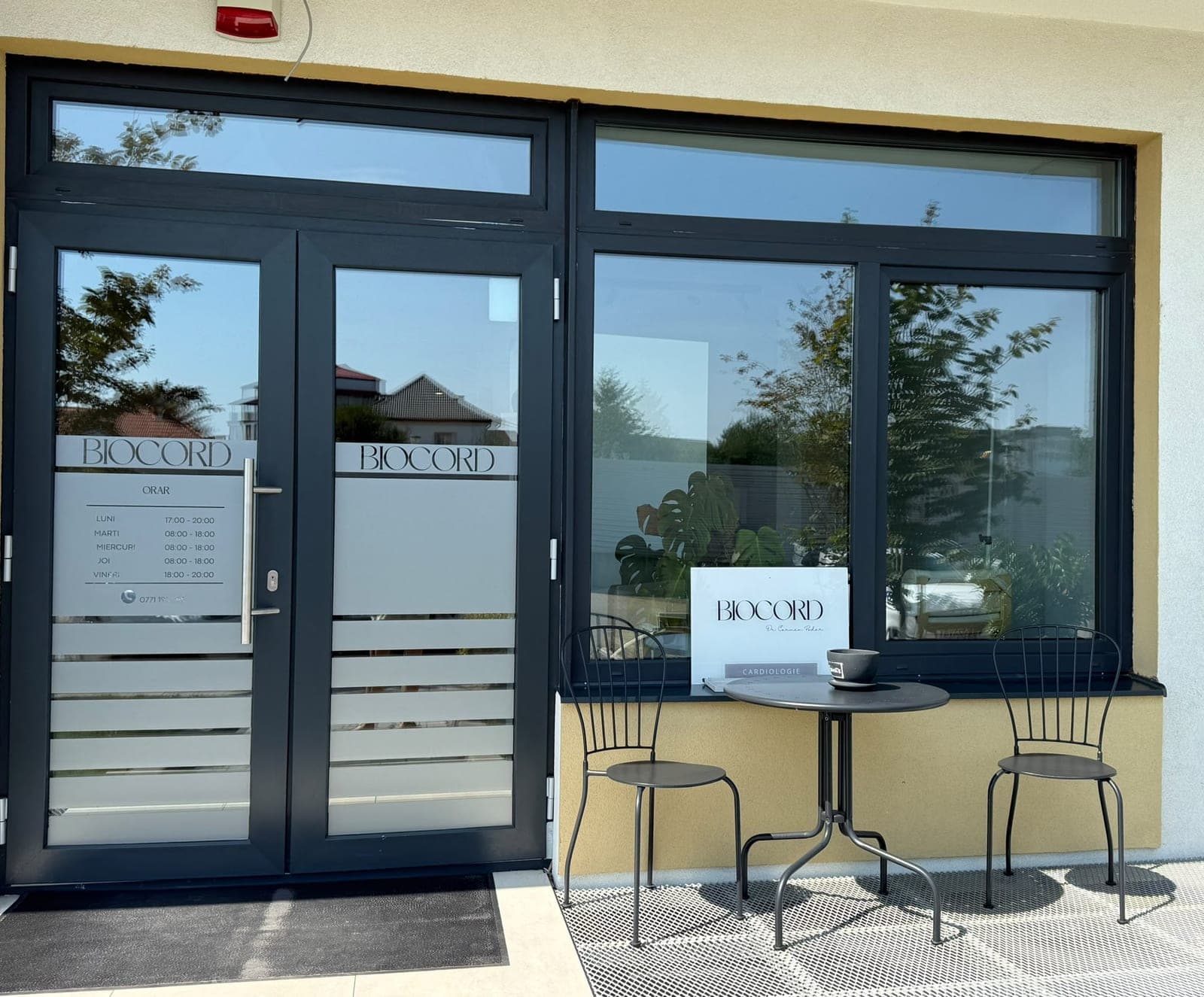
Services that go together with this one
- Holter ECGAn electrocardiogram lasts a few seconds. If your symptoms show up in the evening, during exercise or once a week, you need a continuous recording that can catch them.
- Cardiology consultationA consultation that does not stop at the reason you came in. We go through your history, your test results, your lifestyle and your risk factors, then build a long term prevention plan together.
- Body composition analysisWeight on its own says almost nothing. Body composition shows the balance between fat and muscle, and that is where the practical recommendations start.

Book blood pressure monitoring (abpm)
We confirm the time by phone and tell you whether any preparation is needed.