
Exercise test · Sibiu
Cycle ergometer exercise test in Sibiu, to see the heart at work

A heart can behave impeccably at rest and struggle on a flight of stairs. The exercise test records the electrocardiogram and blood pressure at the very moment more is asked of it.
What a cycle ergometer exercise test is
An exercise test records your electrocardiogram and blood pressure while you pedal on a medical bike, the cycle ergometer, with the resistance rising step by step. The point is to see how your heart behaves when more is asked of it, not only how it looks at rest, at the clinic.
Many heart problems are silent at rest. A narrowed coronary artery can let enough blood through while you sit in a chair and fall short only when you climb three flights of stairs. Controlled exertion at the clinic reproduces exactly that moment, but with the electrocardiogram running and the doctor beside you.
During the test we follow several things at once: the changes on the electrocardiogram, the way blood pressure rises or falls, the heart rhythm, and the symptoms you describe, from chest pain to breathlessness or tired legs.
What comes out at the end is a picture no resting investigation can give: how much exertion your heart takes, at what threshold problems appear, if they appear at all, and how well your body recovers afterwards.
When it is recommended
The test answers a precise question, so it makes sense when that question exists. It is not a routine investigation for everyone.
- You get chest pain or pressure on exertion that goes away at rest
- You are short of breath during efforts you managed without trouble last year
- You have several cardiovascular risk factors and we want to assess your coronary risk
- You have been diagnosed with coronary artery disease and we are following how you respond to treatment
- You have high blood pressure and we want to see how it behaves on exertion
- You have palpitations or rhythm disturbances that only appear when you move
- You want to return to sport after a long break, after 40, or after a cardiac event
- You need an assessment of your exercise capacity before a rehabilitation programme
The test is not performed during an acute heart attack, in unstable angina, in decompensated heart failure, in uncontrolled arrhythmias or in severe symptomatic aortic stenosis. In those situations the guidelines rule it out and the assessment is done differently.
How it goes, step by step
Set aside about an hour for the whole visit. The pedalling itself usually lasts between eight and fifteen minutes.
Getting ready
Come in loose clothes and comfortable shoes you can pedal in. Your last meal stays two or three hours before, and coffee and tobacco are avoided on the day of the test. Do not stop your medication on your own: if a beta blocker needs to be paused beforehand, I will tell you when you book.
Placing the electrodes
The electrodes are stuck on your chest, the blood pressure cuff goes on your arm, and a resting trace is recorded along with your starting blood pressure. Men with chest hair usually need a small shaved patch where the electrodes go.
The effort
You start pedalling against a light resistance, which then rises gradually, in steps or continuously. The electrocardiogram is watched throughout and blood pressure is measured at regular intervals. You say any symptom out loud, as it appears.
Stopping
The test stops when you reach the target heart rate for your age, when changes appear on the electrocardiogram or symptoms call for it, or when you cannot carry on. There is no score to pass; stopping because of fatigue is a result, not a failure.
Recovery
You stay monitored for another six to ten minutes after the effort, because some changes only appear in the recovery phase. We follow the trace, the blood pressure and how your pulse comes down.
The result
We go through the result in the same visit: what the test showed, at what level of effort, what it means for your treatment and what comes next. You leave with the interpretation in writing.
Bike or treadmill
An exercise test can be done on a treadmill or on a cycle ergometer. The clinic uses the cycle ergometer, and the choice has practical reasons, not fashionable ones.
On a bike the body stays stable and the arms stay relatively still. That means an electrocardiogram trace less disturbed by movement and blood pressure readings that are easier to take during the effort.
For patients with balance problems, sensitive knees or hips, or a fear of walking on a moving belt, pedalling is clearly more accessible. The effort can be dosed finely, in watts, and raised continuously rather than in big steps.
The thing to keep in mind is that on a bike the effort often stops because of muscle fatigue in the thighs, before the heart is worked to its maximum. That is why the result is always read together with the level of effort reached, expressed in watts, not only as a positive or negative verdict.
What the result means
A negative result means that, at the level of effort reached, no changes appeared that would suggest ischaemia. It is not a guarantee that the arteries are perfectly clear, but it is reassuring information, especially if you reached a good level of effort.
A positive result means changes appeared on the electrocardiogram, or symptoms, or an abnormal blood pressure response, suggesting that part of the heart is not getting enough blood on exertion. What follows, depending on the case, is a stress echocardiogram, a scintigraphy or a coronary angiogram.
An inconclusive result comes up when the test was stopped early, usually because of fatigue, or when the trace cannot be interpreted because of pre-existing changes. In that case we choose another method rather than repeating the same test indefinitely.
Besides the verdict, the test also gives a measure of your exercise capacity. That number matters in itself: it says how fit you are, it helps set the intensity at which you can exercise safely, and it can be compared at later check-ups.
How safe it is
The test is done under continuous medical supervision, with the electrocardiogram on screen and the option to stop the effort at any second. Precisely because it is controlled exertion, it is safer than the same effort made alone, in the street or at the gym.
Complications are rare. The most common are a drop in blood pressure after stopping, passing dizziness, and extra beats that settle with rest. Serious events are exceptional, and the contraindications above exist exactly to avoid them.
You can stop the test at any time, for any reason. You have nothing to prove: the useful information comes from how your heart reacts, not from how many minutes you last.
Prices
| Service | Price |
|---|---|
| Cardiology consultation + ECG | 400 lei |
| Cardiology consultation + ECG + echocardiography | 620 lei |
| Cardiology follow-up + ECG | 300 lei |
| Echocardiographyincludes an orientative assessment of the liver, the carotid arteries and the thyroid | 400 lei |
| Holter ECG monitoring24 hours | 370 lei |
| Ambulatory blood pressure monitoring (ABPM)24 hours | 370 lei |
| Exercise stress test on a cycle ergometer | 450 lei |
| Body composition analysis | 100 lei |
| Ankle-brachial index (ABI)with interpretation | 100 lei |
| Electrocardiogram (ECG) | 100 lei |
| ECG + SDS (sudden death screening)extended BTL assessment, for people up to the age of 35 | 150 lei |
| Intravenous Ferinject 500 mgmedication and medical supervision included | 800 lei |
| Intravenous vitamin C (Pascorbin 7.5 g)product and medical supervision included | 350 lei |
You have seen the prices. Shall we go ahead?
Tell us what brings you to a cardiologist and we will suggest a time that works for you.
Frequently asked questions
How long does the exercise test take?
How do I prepare?
Should I stop my medication beforehand?
Is it dangerous?
What if I cannot pedal long enough?
Why a bike and not a treadmill?
What does a positive test mean?
Does a negative test mean my heart is healthy?
Can I have the test if I have high blood pressure?
Can I go to work afterwards?
Is it useful before going back to sport?
Can it be done on the same day as the consultation?
Exercise test in Sibiu
The Biocord practice is at Strada Ion Agârbiceanu 11, Sibiu, in the Turnisor neighbourhood.
Phone: 0771 193 295
Email: bio.cord@yahoo.com
Appointments are made by phone or through the form on this site. We confirm the time before you come.
Open in Google Maps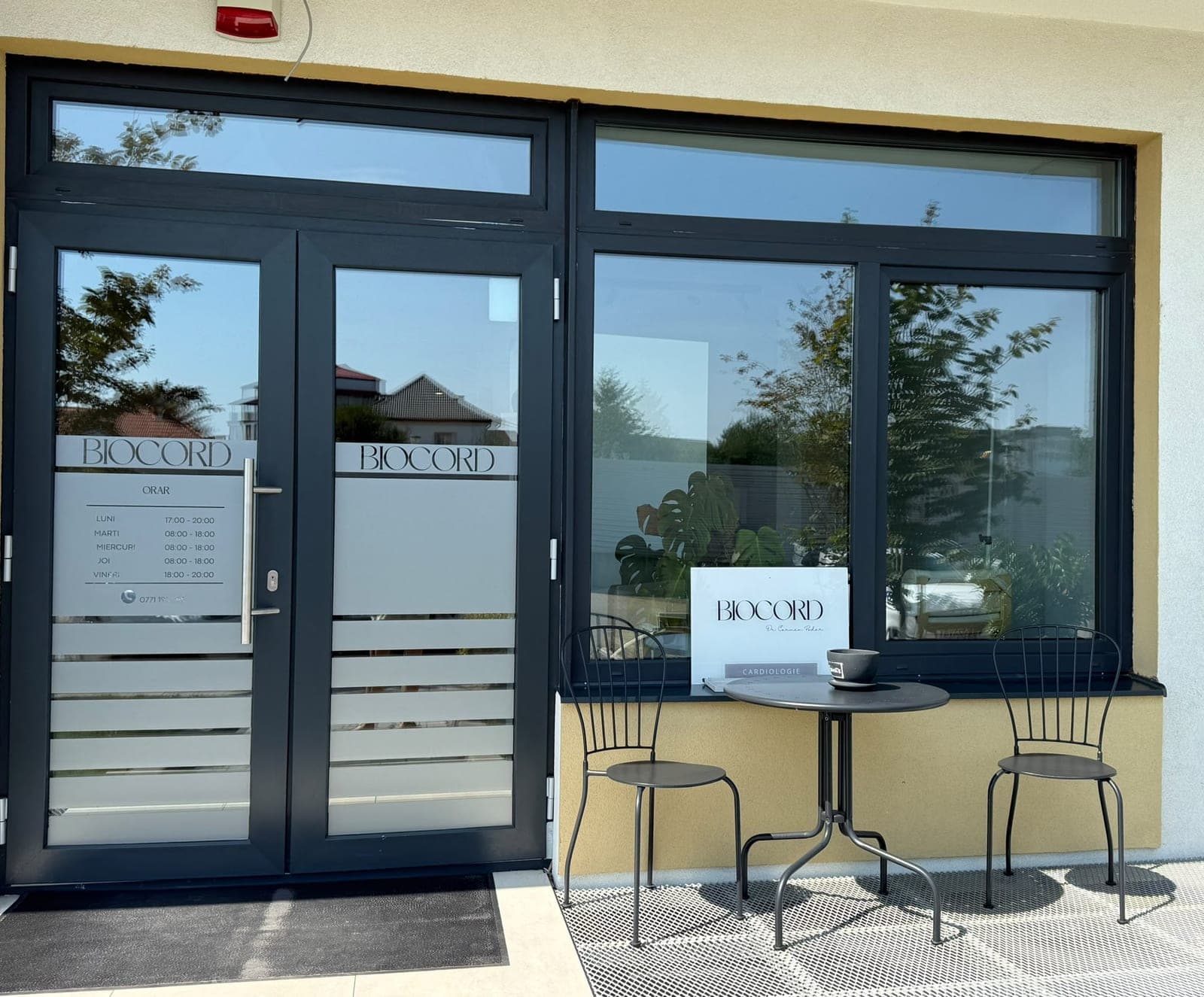
Services that go together with this one
- Cardiology consultationA consultation that does not stop at the reason you came in. We go through your history, your test results, your lifestyle and your risk factors, then build a long term prevention plan together.
- Electrocardiogram (ECG)The basic test of the heart: a few minutes, with no discomfort. Its value lies in the reading, that is, in what your tracing means alongside the rest of your story.
- EchocardiographyA heart ultrasound shows how your heart looks and how it works. In the same session we take a preliminary look at the liver, the carotid arteries and, when needed, the thyroid, at no separate cost.

Book exercise test
We confirm the time by phone and tell you whether any preparation is needed.